【2023レポート】④武生国際作曲ワークショップ(9月4日)(神山奈々氏)

武生国際音楽祭2023と連動して、第22回武生国際作曲ワークショップも開催中です。その様子を、作曲家の神山奈々さんに紹介していただきました!

 第22回武生国際作曲ワークショップは、9月4日から開講されました。今年はリトアニア、エストニア、セルビア、ポーランドといったヨーロッパの周縁諸国をバックグラウンドに持つ作曲家を招き、開かれた学びの場として多くの受講生を迎えています。近年は、アジア諸国からの受講生が増えており、多様な文化的背景が一つの場所で重なり合い起こす化学反応を肌で感じることが出来ます。誰にとっても「武生」での経験が特別なものになることを切に願って、熱い一週間が始まりました。

 初日は、二人の作曲家による「自作を語る」。一人目は、日本の作曲家、坂田直樹さん。日本とフランス、両国で学ばれたご経験からそれぞれ何を得て、それらがご自身の音楽とどのように結びついているかについて丁寧にお話し下さいました。また、近作のオーケストラ作品を取り上げ、オーケストレーションの方法や、その中における楽器法の拡張についてフォーカスした内容となりました。    二人目は、セルビア出身、ドイツを現在の拠点としている作曲家のフリスティナ・スザクさん。作品のユニークな音響が一瞬で受講生の耳を啓きました。具体的な過去の作曲家の作品を例にとり、それらがご自身の創作とどのように関連しているか分かりやすくお話し下さいました。「始源の音」を彷彿とさせる作品群は、プリミティブな魅力に溢れているのだけれど、一方ではとても知的でそのアンバランスさが魅力的な方です。

 また、リコーダーの鈴木俊哉さん、尺八の田嶋直士さんによる、楽器のレクチャーもありました。二つのエアリード楽器の実演を聴きながら比べると、その共通点や違いにもたくさん気付かされました。

 二日目は、リトアニア出身のユステ・ヤヌリテさんの「自作を語る」で始まりました。美学的なものと時間の概念が結びついたフォームの美しさを作品から率直に受け取ることが出来ました。ご自身の方法論についてのお話は、音の素材をどうやって限定するか、またその楽器法と音色についてなど大変具体的でした。そして私にとっては、どうやって学生の作品を指導するかという話も興味深く聞きました。続いてポーランドのコンポーザーピアニスト、アンジェイ・カラウォフさん。私は自作のリハーサルがありこのレクチャーを聞くことが出来なかったのですが、音楽祭に参加する演奏家の友人から面白いエピソードを伺いました。カラウォフさんはこの音楽祭で日本初演となる曲を発表されますが、ピアノをご自身で弾きながら、リハーサルを進められているそうです。それはとても音楽的で直感で掴みやすいコミュニケーションによるリハーサルの時間だったと聞きました。「新しい地平コンサート」で聴けるのを楽しみにしています。

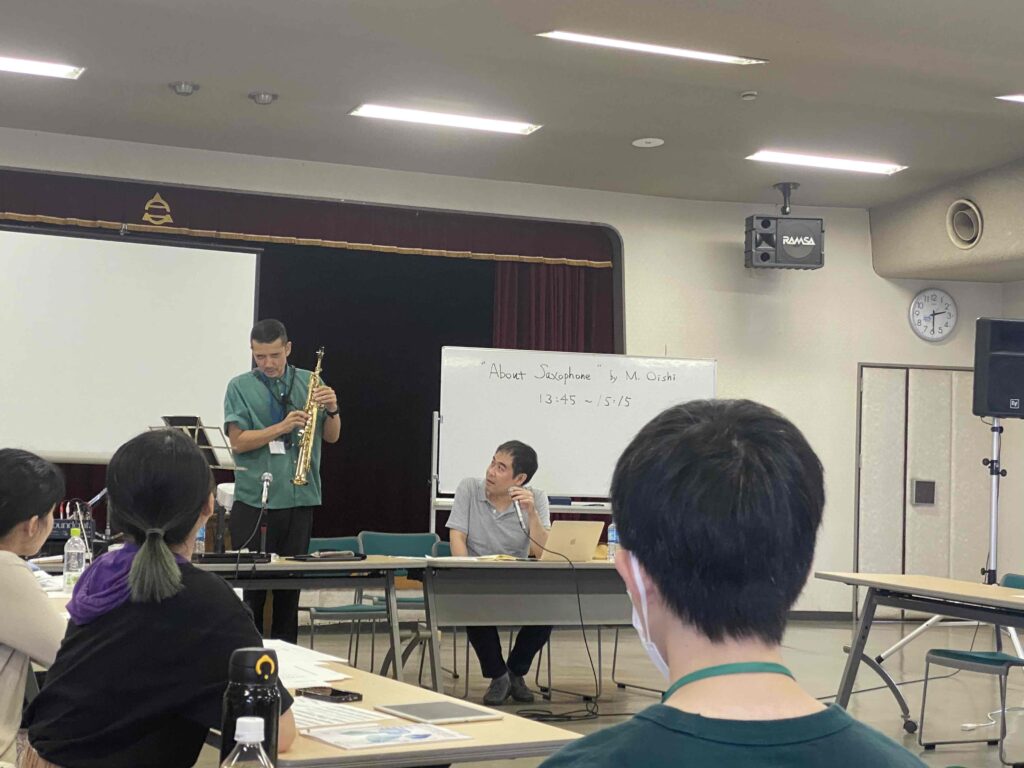
 サキソフォンの大石将紀さんよる楽器のレクチャーでは、9日に演奏されるマーク・アンドレの作品を取り上げ実演を交えながら、その場にいる受講生を含む作曲家と対話を行う形式で密な質疑応答が繰り広げられました。

アコーディオンの大田智美さんによる楽器のレクチャーでは、作曲の際に大変有用な資料を多く得ることとなりました。

明日は、ワークショップの皆さんと遠足です。この短評を書いていてまだ眠れないのですが、遠足が楽しみ過ぎて眠れないことにしようと思います。

【2023レポート】③ギター、ソプラノ、ヴィオラが紡ぐ抒情(木下正道氏)

武生国際音楽祭2023レポート第3弾。今回は作曲家の木下正道さんです!

9月6日(水)メインコンサートの「ギター、ソプラノ、ヴィオラが紡ぐ抒情」を聴きました。

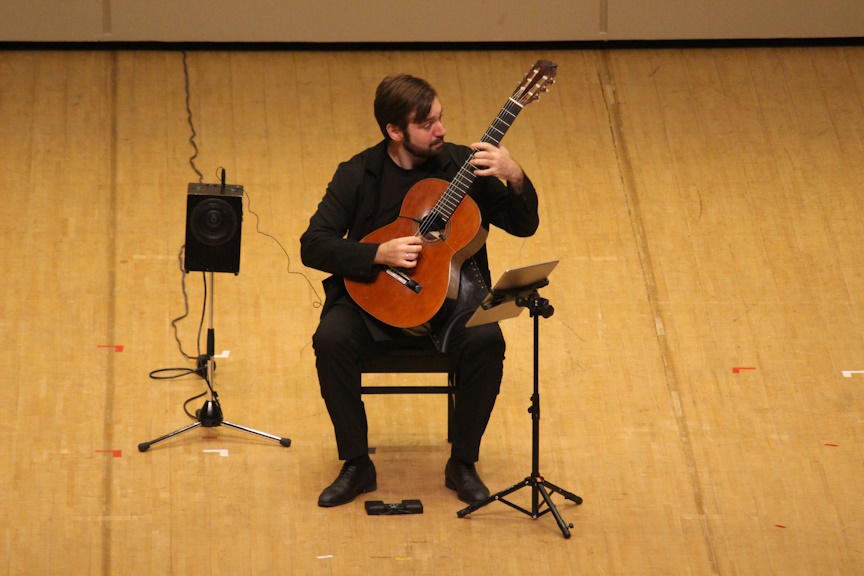
まずは、この音楽祭の音楽監督である細川俊夫さんの、ギターソロによる編曲集「日本のうた」の日本初演でした。 我々日本人ならばほぼ誰もが知っている、12のうたが、ギターの演奏技巧を駆使しつつもそれがあまり表に出ずに、音楽そのものをぐっと引き立てることに徹した素晴らしい編曲と、それを真摯に、丁寧に音、音楽として紡いでいくジェイコブ・ケラーマンさん(「今日の演奏会でわたしだけがこれらの曲を知らない」と仰られていたようですが)のギター演奏は、とても感動的でした。 細川さんはお話で「(使い古された)骨董品を磨くように」と仰っておられましたが、その試みは十分に成功し、懐かしくも新しい音の世界が生まれました。

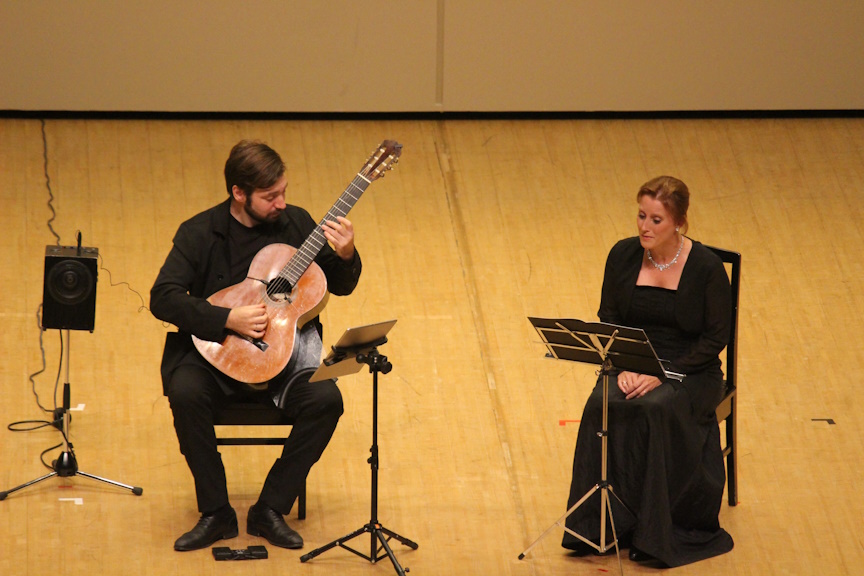
そして盛大な拍手に応えて、アンコールとして、細川さん編曲の「五木の子守唄」が、ソプラノのイルゼ・エーレンスさんと、ジェイコブさんのギターで演奏されました。旋律と伴奏は繰り返すたびに少しづつ変化していき、夕焼けの中ゆっくりと日が沈むような(日本的)風情を、イルゼさんとジェイコブさんは全く的確に表現されていました。

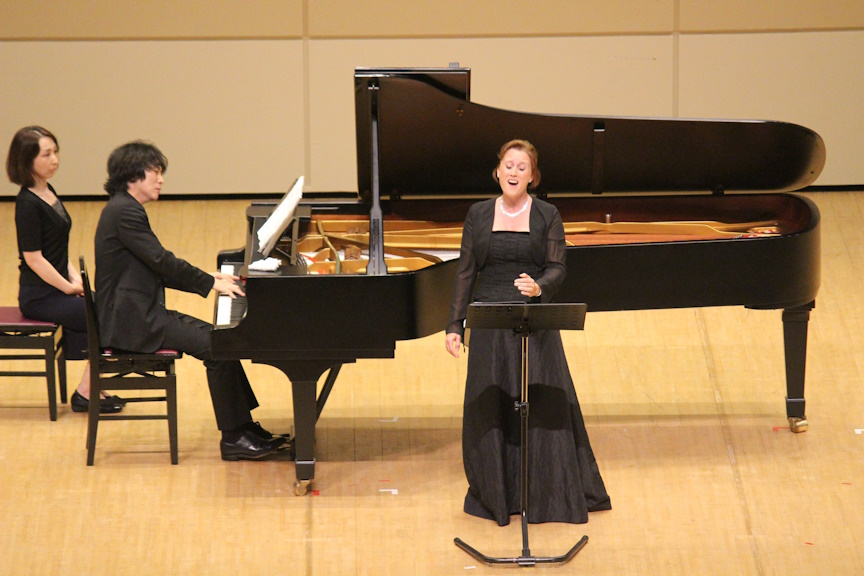
転換を挟んで、次はリヒャルト・シュトラウスの「4つの最後の歌」が、イルゼさんのソプラノと北村朋幹さんのピアノで演奏されました。R.シュトラウスの「4つの最後の歌」は、作曲者最晩年の作品ですが、彼らしい色彩感あふれる音楽の中に、そこはかとなく漂う寂寥感や、人生の肯定と死の影がないまぜになった淡い光が立ち込めています。また晩年の巨匠らしい簡潔さもあります。イルゼさんは、満ち引きを繰り返す潮のように、うねりと輝きのある声の様々な表情を巧みに操り、広がりある歌を歌っていきます。北村さんの一切音に濁りのないピアノは、品位を保ちつつ歌と対等に対峙して、R.シュトラウスの書いた音符の意味を描き出していきます。 そして、終曲のまさに最後に、ピアノだけ残ってどこまでも沈黙に向かって進んでいく(もちろんそこには歌の残り香があります)ところなど、まさに彼岸の世界を垣間見るようでした。

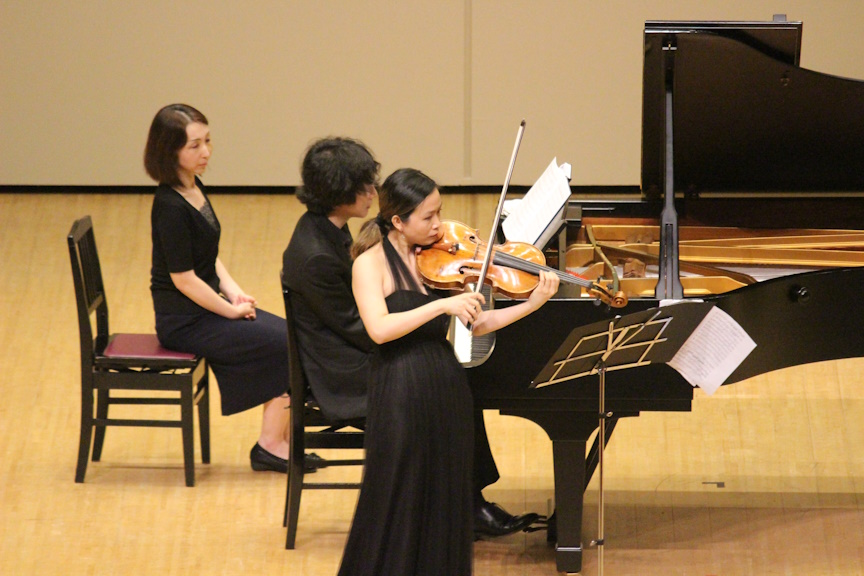
休憩の後は、ショスタコーヴィチのこれまた最晩年の作品「ヴィオラソナタ Op.147」が、ルオシャ・ファンさんのヴィオラと、北村さんのピアノで演奏されました。 この曲には、ベートーベンの「月光」を始めとする多くの引用があります。それを色々推測するのも楽しい聴き方なのですが、今回の演奏ではそういうことよりも、まず書かれた音を演奏として如何に彫琢するか、その究極的な姿を見たように思いました。 北村さんは「虚無」を表現できる稀有な音楽家の一人だと思います。ここでの「虚無」とは、単にからっぽ、という意味ではなく、喜怒哀楽を始めとする様々な感情や、禍々しいもの、恐怖を覚えるもの、また至福の世界を見せるもの、の源泉、原型となるような、何か、です。ショスタコービッチの晩年の音楽は、切り詰めたギリギリの音の動きによって、そういった「虚無」の世界に近づいていると思うときがあります。北村さんはそれを自分の音として丁寧になぞり、そこで表情豊かで時に厳しい造形を持つルオシャさんのヴィオラが自在に歌います。極めて純粋な音楽の姿を引き出したこの演奏は、まさに画期的なものだと思いました。

細川俊夫と仲間たちコンサート プログラムノート英語版 (9月8日)

武生国際音楽祭2023、9月8日の細川俊夫と仲間たちコンサートの英語版プログラムノートです。日本語版については、武生国際音楽祭2023で販売中のプログラム冊子等をご参照ください。

Märt-Matis Lill : My Weeping Voice Is the Wind of Autumn
(Mario CAROLI/flute, UEDA Nozomi/clarinet, KASAI Tomoko/percussion, OYA Saori/piano, HEMMI Yasutaka/violin, MIZUNO Yuya/cello)

For a long time, I have been interested in something that could be called an opposition between the objective and the subjective in music as well as in art in general. I used to prefer more objective or distant ways of expression in my creative practice, but lately I have been enjoying the idea of incorporating a more intimate and emotional approach. I see the conflict and concordance between these two opposites as similar to the relation between nature and man. I draw inspiration from classical Asian poetry which deals extensively with the relation of nature and man. The title of my work is taken from one such poem:

Shake oh tomb! My weeping voice is the wind of autumn.

This haiku, considered one of the most powerful in Japanese literature, was written by Basho after the shocking and untimely death of his closest friend. Hence the unusually emotional style, where nature and man (the objective and the subjective) are joined in a unique and expressive way, unprecedented in haiku tradition. I tried to convey this interconnectedness in my music. I wrote this piece while thinking of two young musicians whose trip to Finland in autumn 2005 ended at the bottom of the sea.” (Märt-Matis Lill)

Justė Janulytė : Aria
(Quartet Integra)

The form of „Aria“ for string quartet (2008) resembles roaming through a labyrinth constructed from a short melody which is being continuously defragmented changing the order of its phrases thus complicating more and more the possibility of reaching the exit until a sort of a solution is found while returning back to the starting point. The piece was commissioned by the Thomas Mann festival in Nida (LT) and written for Kaunas string quartet. First performance: Thomas Mann festival, Nida (LT) | 12th of July 2008 (Justė Janulytė)

Hristina Šušak : Wind of Fuji
(TAJIMA Tadashi/shakuhachi, SUZUKI Tosiya/recorder)

When I was in Japan in December last year, I was very inspired by the culture and atmosphere. Exactly during this trip I got the idea for this piece called Winds of Fuji. Although I didn’t visit Fuji the whole atmosphere in Japan inspired me and gave an image and sound in my head. The piece is based on the motif of a small third (interval) which is being elaborated in many ways using several playing techniques and musical parameters. The intensity regarding all present musical materials is changing constantly without some particular (for us) noticable rules, just like wind. (Hristina Šušak)

Naoki Sakata : Invisible River
UENO Yoshie/flute, UEDA Nozomi/clarinet, KASAI Tomoko/percussion, Quartet Integra)

As the title “Invisible river” suggests, this piece is composed of textures reminiscent of fluids. At the same time, I treated the gap in the time and space as the important materiel with the Japanese concept “Ma”. As a result, silence and tranquil textures are inserted from the middle of the piece onward. Inspiration from the shakuhachi played an important role in the composition process. For example, the music of the shakuhachi is formed by a variety of wavering sounds such as “yuri” and “korokoro. In addition, the “one sound” played by this instrument is a very complex mixture of pitched sound and breath noise. Thus, this work is constructed by various fluctuating effect and complex sound. Because of the pursuit the instrumental technique for this theme, the piece includes a scene in which the strings are played with wooden sticks. The use of sticks coated with rosin allows a delicate organization of noise and musical sounds. (Naoki Sakata)

Toshio Hosokawa : Extasis
(MOHRI Fumika/violin)

This work was composed from the end of 2015 to early 2016 for Sayaka Shoji. To me, the primitive form of music is in Shamanism. In order to pray, from this world to the other world, Shamans will communicate with a world we cannot see in our daily lives through singing. The appearance of Sayaka Shoji performing the violin as a solo, for me, is the form of a Miko. She uses the violin as an extension of her own voice (song), and by trying to be united with the immense energy of the universe flowing within and outside of her, she sings. Exstasis means to go beyond oneself. It is the desire to leave the order of the ordinary life; it is to leave from the ego, and also an uncontainable impulsive greed to the depth of a figure (chaos) like a bottomless swamp. From the player (miko) to the space and to the void, the sound of the violin has brush stroke-like shapes of an eastern calligraphy. The piece was revised by the composer in 2020. (Toshio Hosokawa)

Toshio Hosokawa : Klänge von Lethe
(UENO Yoshie/flute, OKAMOTO Yuya/cello, KITAMURA Tomoki/piano)

This work was composed for the trio of Emmanuel Pahud (flute), Jean-Guihen Queyras (violoncello), and Eric Le Sage (piano), and is related to The Water of Lethe for piano quartet composed in 2015. I believe the act of composition is to listen to the “river of sounds” that is always flowing in our cosmos, and write them down on music following my own method. It is said that the ancient Greek believed, for the reincarnation of their souls, they would be forced to drink the water of Lethe after death in order to erase their memories of previous lives. The quiet flow of river Lethe, which is for forgetting the deep sorrows and sins of this world, stimulates my imagination. The flow of the river teaches us that the time constantly passes by without pause, and at the same time teaches us that new time is constantly created. The sorrow of passing by and the hope of being newly regenerated exist together there. From Alphonse de Lamartine Le Vallon J’ai trop vu, trop senti, trop aimé dans ma vie; Je viens chercher vivant le calme du Léthé. (I have seen much, felt much, loved much in my life; And, still living, come to seek the calmness of Lethe.) (Toshio Hosokawa)

Toshio Hosokawa : Drei Engel-Lieder
(Ilse EERENS/soprano, YOSHINO Naoko/harp)

Angels exist between this world and a world beyond this world that cannot be seen. They are the messengers who let us see a glimpse of the other world. In recent years, I have become interested in shamanism and have composed music where the musicians assume the role of shamans who let us see the world beyond this world through the use of sound. In this work, the soprano plays the role of both an angel and a shaman (miko). The texts I’ve chosen are by a female Jewish German poet, Else Lasker-Schüler, and a Jewish philosopher, Gershom Scholem. (Toshio Hosokawa)
新しい地平Iコンサート プログラムノート英語版 (9月8日)

武生国際音楽祭2023、9月8日の新しい地平Iコンサートの英語版プログラムノートです。日本語版については、武生国際音楽祭2023で販売中のプログラム冊子等をご参照ください。

Nana Kamiyama : Mirage over the ancient forest under the sea
(HEMMI Yasutaka/violin, MATSUMURA Takayo/harp)

About 90 kilometers from my workplace in Kanazawa, I drove towards the Sea of Japan. It’s said that in the bay where I arrived lies a primeval forest from two thousand years ago, deep beneath the sea floor. The twisted tree roots remain, perhaps now serving as beds for deep-sea fish. Separated by the surface of the sea, it’s said that one can see a mirage, with the elongated shapes of a city towering high. Alone, I stood on the bright sandy beach, reminiscing about stories of firefly squids washing ashore. On moonless nights, the dark beach is said to glow pale blue. I’ve always wanted to witness such a scene, but I didn’t have much time left. As I was about to leave the beach, a gleaming fragment containing luminous minerals caught my eye. “Ah, a shard of jade,” I intuitively thought. Drawing close and picking it up, I held it up to the sun to examine the crystals and noticed a mirage appearing in my line of sight. A beautiful scene, it was an illusion. The once vast beech forest; echoes of life. At the ends of those tree branches, birds were singing. Wait, was I once such a bird? Do you still remember such distant memories, I wonder? (Nana Kamiyama)

Isamu Kanai : FIELD
(YAMAMOTO Junko/piano)

The title is borrowed from the trend in abstract painting known as “Color Field Painting,” which involves creating a “field” of colors on a large canvas. I feel that the piano is a “Gigantic Resonator”. In my imagination, the depth of sound emitted by piano intersects with the expansiveness expressed through colors. These shared elements inspired me to explore the emergence of a new “FIELD” of sound. (Isamu Kanai)

Hristina Šušak : Affectus I
(UEDA Nozomi/clarinet, HEMMI Yasutaka/violin)

In Affectus I as well as in other Affectus pieces (Affectus I, II, III and IV) I use very reduced spectrum of music material; in fact, only two kind of sound: downward glissando and percussive element. These two I combine in an unpredictable way, using contrasts in dynamics and length, like an affectus. I also try to gain some kind of homogeneity (as well as in my music in general) for example, using the same kind of sound in both instruments simultaneously, adjusting their playing techniques, but with complementary rhythm – what creates some form of what I call sound mass in the end effect. (Hristina Šušak)

Naoki Sakata : Candela
(UEDA Nozomi/clarinet)

The title “Candela” is a unit of luminous intensity. As the title suggests, the work is colored with various images of light, from a flashing sound in high register to a obscure effect by delicate multiphonics. The word “candela” is derived from the word “candle,” and the music also projects figures related to fire. For example, the piece makes extensive use of sound materials with “continuous and rapid sound fluctuations,” such as trills and frequency beat by multiphonics, which evoke the flickering of fire. The work is composed of three parts: fast, slow, and fast. In the first part, a variety of movements are derived from a fire-tip-like sound pattern that repeatedly rises, and irregular textures are woven together. Second part is based on delicate sounds such as the weak mulciphonics. Third part is composed with dynamic texture. Here, double trills with special fingerings create a sound image like a glowing flame. (Naoki Sakata)

Hinako Takagi : Reflection of Heaven
(SUZUKI Tosiya/recorder, TAJIMA Tadashi/shakuhachi)

The term “heaven’s reflection” is used by Yoshikawa to express the connection between the order of the world and one’s own existence in the collection of conversations between philosopher Keiji Nishitani and Chinese literary scholar Kojiro Yoshikawa, “This Eternal Thing.” It is something. Even in the midst of modern science and the rapidly changing order of things, we feel a deep connection with heaven. Or, there are quite a few situations where you want it. What kind of reflection does the modern order have on us today? I composed this piece while thinking about the relationship between heaven and humans that has continued since ancient times, and its changes. (Hinako Takagi)

【2023レポート】②弦楽四重奏「古典」の系譜(神山奈々氏)

武生国際音楽祭2023レポート第2弾。今回は作曲家の神山奈々さんです!

9月5日(火)メインコンサートは伊藤恵プロデュースによる、弦楽四重奏「古典」の系譜。この日の曲目は、ハイドン作曲「弦楽四重奏曲 第34番」、

バルトーク作曲「弦楽四重奏曲 第6番」、ドヴォルザーク作曲「弦楽四重奏曲 第12番『アメリカ』」でした。

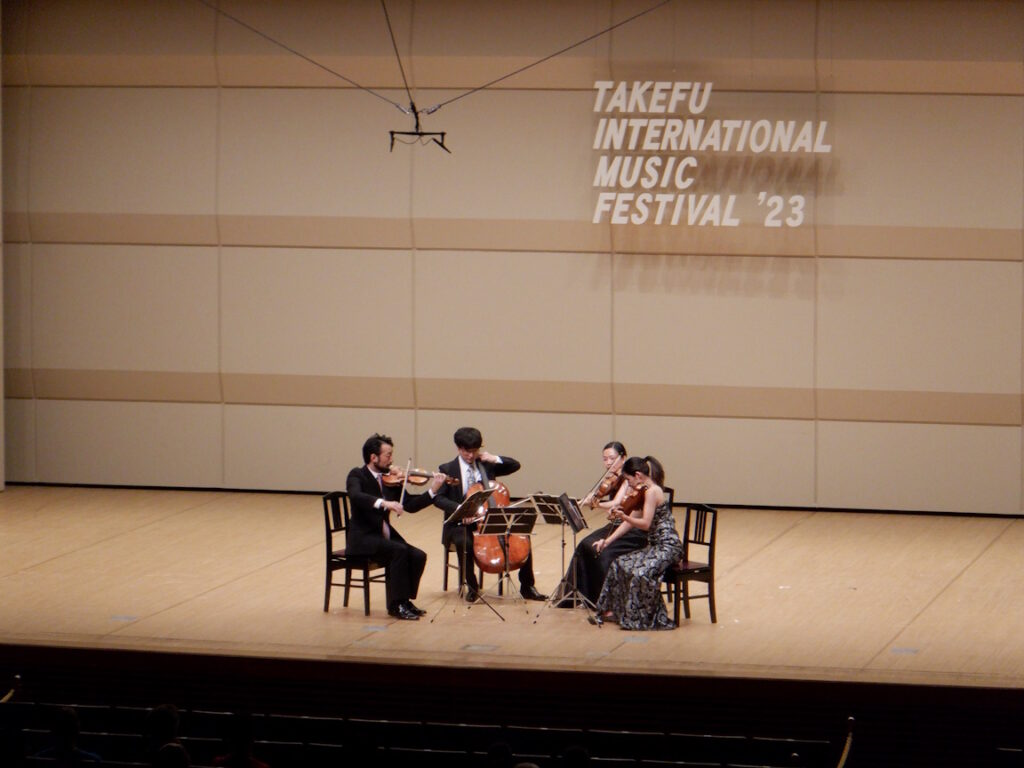
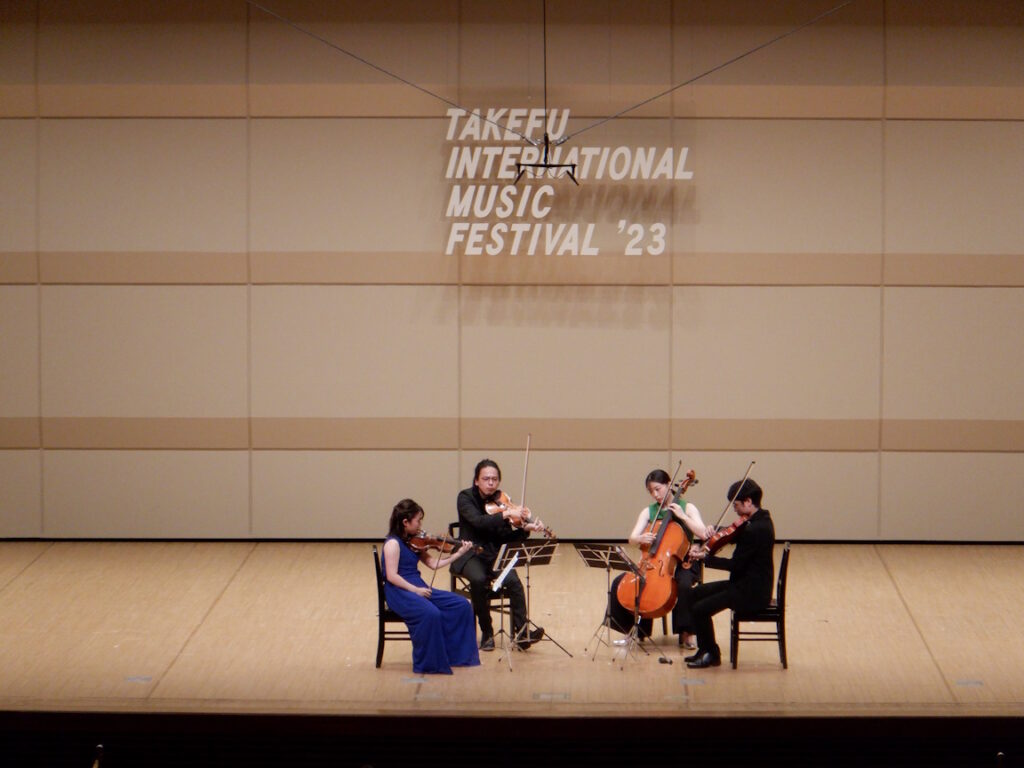
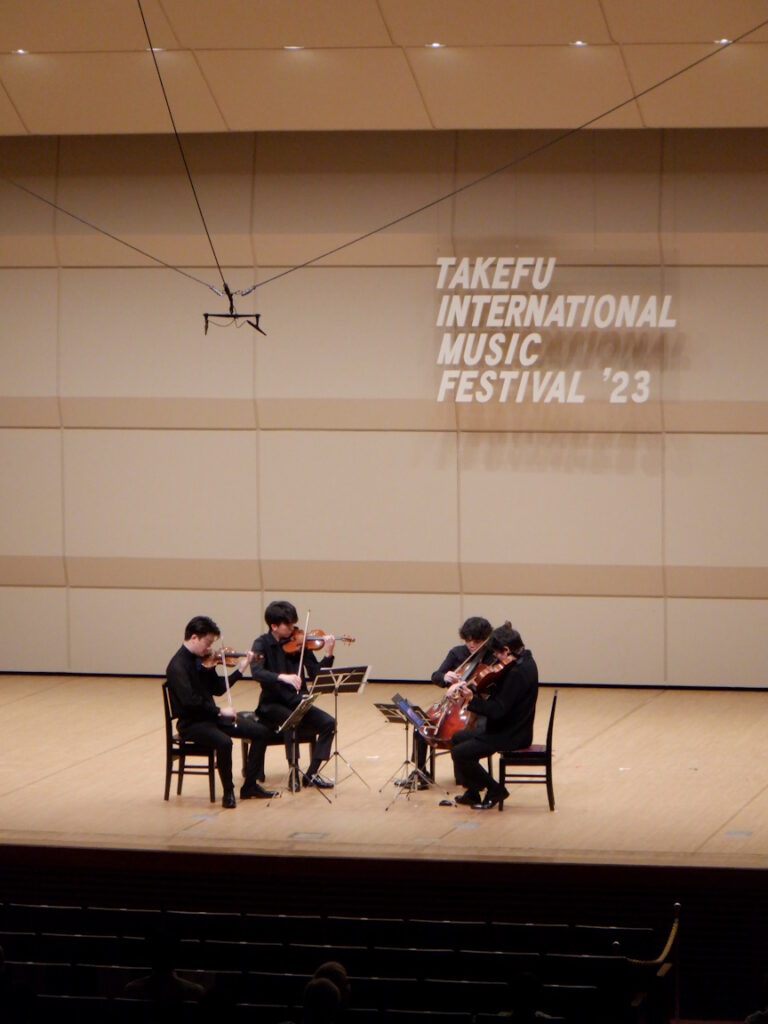
これら3曲は、12人の弦楽器奏者によって演奏されました。この中で、四重奏団を組んでいるのは「クァルテット・インテグラ」の4人、それ以外は超一流のソリストの集まりとして成立している四重奏が2組ということです。一つのコンサートの中で、この差を聴くことが出来るというのが特殊で貴重な体験でした。

ハイドン作曲「弦楽四重奏曲 第34番」では、NHK交響楽団のゲスト・コンサートマスターを務めた白井圭さんの作る1stヴァイオリンとしての推進力がある音楽に、若い世代のホープである2ndの外村理紗さんが寄り添うのでは無く、望んで一体となっていくようなアンサンブルが見られました。それはまるでソリスト同士の出会いとお互いの尊敬の眼差しを聴くようなやり取りでした。とりわけ第2楽章では、音色の共有にこだわった演奏が、コミュニケーション豊かなリハーサルを窺わせました。白井さんの身振りと音色は、ヴィオラのルオシャ・ファンさんとチェロの岡本侑也さんに確かに受け継がれていて、その軌跡を聴くことは希望に満ちた体験だったと思います。

 続いては「クァルテット・インテグラ」によるバルトーク作曲「弦楽四重奏曲 第6番」。私は、弦楽四重奏団というのは寝食を共にして、初めて自分たちの声を手にするようなイメージがあります。彼らがそれらを経てTuttiで手にしたのは非常に艶やかな音色。精緻なアンサンブルの中、時折聞こえてくるインテグラ独自の音というのが明確に、この四重奏団のキャラクターを描いていました。それは、この4名が弦楽四重奏団として存在する必然性を感じさせるのに十分な美しさでとにかく凄い、素晴らしいの一言に尽きる演奏でした。

最後は、ドヴォルザーク作曲「弦楽四重奏曲 第12番『アメリカ』」。こちらは個性のぶつかり合いとも言えるようなソリスト同士の熱い戦いでした(殴り合いみたい)。その中で、1stヴァイオリンの郷古簾さんの表現が際立っており、東欧への望郷を感じさせるものだったことは「アメリカ」の中におけるローカルであることの強さのようなものをドヴォルザークの当時の状況と重ねながら聴きました。このように多層的な背景を感じさせる個性のハイブリッドな弦楽四重奏というのは、その歴史において新しい価値観かもしれない、と思いました。2ndの山根一仁さん、ヴィオラの山本周さん、チェロの上野通明さんはそれぞれに異なる表現でドヴォルザークに対峙しています。それらが、1曲の中で聴こえてくると新しくも不思議な音楽体験でした。